
Drs Dadeschools NetDrs Dadeschools Net was what my sister recommended when I asked how she keeps up with all my nephew’s school records. At first, I thought it would be confusing, but she logged in and showed me how easy it was to see attendance, grades, and even teacher notes all in one place. I remember thinking back to my school days when parents had to call or wait for report cards. Seeing it streamlined online made me realize how much smoother and transparent school communication has become.
What is DRS Dadeschools Net?
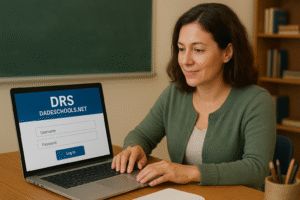
An internal web site designed for employees of Miami-Dade County Public Schools is called the District Reporting System (DRS). DRS was created especially for staff members who require access to comprehensive school, student, and district-level data, in contrast to the Gradebook or Parent Portal, which are intended for students and families.
To put it simply, DRS serves as the district’s “data hub,” assisting schools with managing resources, tracking student achievement, keeping an eye on attendance, and producing reports that inform district-wide and school-level decisions.
Key Features of DRS Dadeschools Net
DRS’s functionality is its strongest point. Among its most crucial characteristics are:
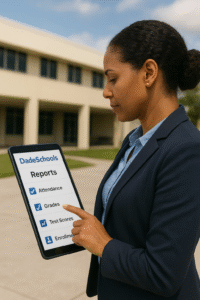
- Student Data Management: In a single location, educators and administrators may view student profiles, attendance, grades, and test scores.
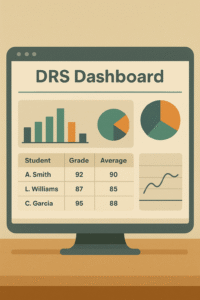
- Custom Reports & Analytics: Schools are able to produce comprehensive reports that examine district-wide objectives, attendance problems, or performance patterns.
- Performance Monitoring: DRS provides district executives and principals with information about how well schools are performing in relation to benchmarks.
- System Integration: To guarantee data consistency and correctness, DRS communicates with other MDCPS systems.
This makes it more than simply a reporting tool—it’s a strong engine for accountability and progress.
Who Can Use DRS Dadeschools Net?
For good reason, not everyone has access to DRS. Since the system includes private student and school data, it is only used for:
- Teachers use it to monitor student performance in the classroom and spot those who might want more help.
- School Administrators – such as principals and assistant principals who supervise performance at the school level.
- District officials make judgments about resources and policies by analyzing data from several schools.
DRS is not directly accessible to parents or students. Rather, they make use of tools like Gradebook and the Parent Portal.

How to Access DRS Dadeschools Net
It’s simple to log onto DRS, however employee credentials are needed:
- Go to Dadeschools.net, the official website.
- Go to the area under Employee Login.
- Enter your MDCPS-provided username and password.
- From the employee services menu, select the DRS link.
Strict security measures are in place since the portal holds sensitive data. Workers are urged to protect their login information and to change their password right away if they think there may have been illegal access.
Common login problems, such as account lockouts or forgotten passwords, may typically be resolved by the district’s IT support staff.
Benefits of Using DRS Dadeschools Net
Data storage is only one aspect of the District Reporting System; another is turning data into insights that can be put to use. Among the main advantages are:
- Improved Decision-Making: Teachers and administrators are able to spot patterns and take early action.
- Better Student Outcomes: Schools may focus resources where they are most needed by tracking performance statistics.
- Efficiency in Reporting: Employees may create reports instantaneously rather than manually.
- Accountability: DRS guarantees openness and assists schools in fulfilling state and district requirements.
To put it briefly, the system increases accuracy, saves time, and fortifies MDCPS’s capacity to provide pupils with quality education.

Security and Privacy in DRS Dadeschools Net
Security is a primary concern for DRS as it handles sensitive student data. Strict privacy policies are enforced by MDCPS, including:
- Role-Based Access Control: Certain types of data can only be viewed by authorized personnel.
- Data encryption ensures that information is stored and sent safely.
- FERPA Compliance: To safeguard student records, the system complies with the Family Educational Rights and Privacy Act.
This guarantees that information is secure and utilized just for teaching.
Comparison with Other MDCPS Tools
There are several digital platforms available from MDCPS, and it’s critical to comprehend how DRS varies from them:
- Teachers, students, and parents can use the gradebook to keep track of assignments and grades.
- Parent Portal: A way for families to communicate and keep track of their children’s growth.
- Instructional Tools: Educational materials used in the classroom on a regular basis.
DRS, in contrast, is centered on reporting and analytics. It gives administrators the “big picture” they need to make wise choices at the district and school levels.
The Future of DRS in Miami-Dade Schools
DRS and similar technologies will continue to develop as education becomes more data-driven. Future enhancements might include:
- dashboards that are easier for instructors to utilize.
- Predicting student needs through integration with AI technologies.
- Mobile accessibility for reporting while on the go.
DRS will continue to play a key role in MDCPS’s digital transformation as part of its dedication to innovation.
Conclusion
More than merely a reporting portal, the DRS Dadeschools Net system is an essential tool that supports the efficient operation of Miami-Dade County Public Schools. By supplying precise data, facilitating decision-making, and upholding accountability, DRS enables educators, administrators, and district leaders to concentrate on what really counts: the achievement of the students.
It is crucial for everyone working in MDCPS to comprehend and use DRS. Systems like DRS will continue to play a key role in enhancing educational institutions and ensuring that students have better prospects as technology in education advances.